How The Performance Of Gear Pumps Can Be Improved
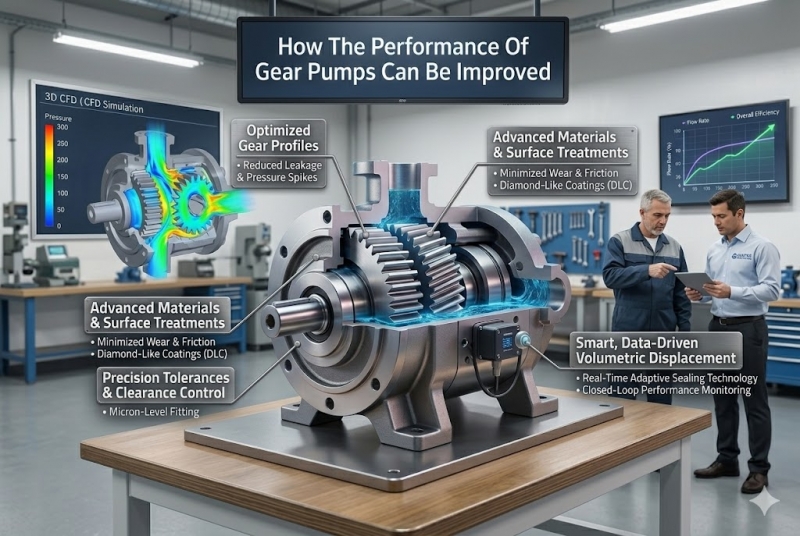
这是我的标题,v帮我做一张图,配合这个,标题要求长宽1536 × 102
A viable circuit to improve the performance of gear oil pumps
Due to the structural limitation of gear oil pump, it is generally believed that gear pump can only be used as a constant flow hydraulic source.
Installing a control valve directly on the pump eliminates the need for piping between the pump and the directional valve, thus controlling costs. Fewer fittings and connections reduce leakage and thus increase operational reliability. Moreover, the valve installed in the pump itself can reduce the circulating pressure of the circuit and improve its working performance. Below are some circuits that can improve the basic functionality of gear pumps, some of which are proven to work, and some of which are innovative research.
Offload the loop
The unloading element will combine a high-flow pump with a low-power single pump. Liquid from the two gear oil pumps is limited by the structure of the fixed displacement, and it is generally considered that the gear pump can only be used as a constant flow hydraulic source. Due to the structural limitation of the gear oil pump with fixed displacement, it is generally believed that the gear oil pump can only be used as a constant flow hydraulic source. However, the combination valve scheme of accessories and threaded connections is effective in improving its functionality, reducing system cost and improving system reliability, so that the performance of gear oil pumps can be close to that of expensive and complex piston pumps. At this point, the high-flow pump circulates the flow from its outlet to the inlet, thereby reducing the pump's output flow to the system, that is, the power of the pump is reduced to a value slightly higher than required for the high-pressure part to work. The percentage reduction in flow depends on the ratio of unoffloaded displacement to total displacement at this time. Combination or threaded connection unloading valves reduce or eliminate tubing, orifice and accessories and other possible leaks.
The simplest unloading elements are manipulated manually. The spring turns the unloading valve on or off, and when the valve is given a manipulation signal, the on-off state of the valve is well switched. A lever or other mechanical mechanism is the easiest way to operate such a valve.
Pilot-controlled (pneumatic or hydraulic) unloading valves are an improvement in the way they are operated, as they can be controlled remotely. Its greatest progress is the use of electrical or electronic switch-controlled solenoid valves, which can be controlled not only remotely, but also automatically by a microcomputer, and this simple unloading technology is generally considered to be the best case for the application.
Manually operated unloading elements are often used in circuits that require large flows for fast action and large flows for fast action and reduced flow for precise control, such as rapidly telescopic boom circuits. When the unloading valve of the circuit has no action signal, the circuit always outputs a large flow. For normally open valves, the circuit will output a small flow under normal conditions.
Pressure sensing unloading valves are the most common solution. The spring action puts the unloading valve in its high-flow position. When the circuit pressure reaches the pre-adjusted value of the relief valve, the relief valve opens and the discharge valve switches to its low-flow position under hydraulic and action. The pressure sensing unloading circuit is mostly used for hydraulic cylinder supply that needs to be fast in the stroke and high pressure and low speed at the end of the stroke. The pressure-sensing unloading valve base is basically an automatic unloading element that reaches the system pressure and is commonly used in odometry splitters and hydraulic vises.
The unloading valve in the flow sensing unloading circuit is also pressed by a spring to a high-flow position. The size of the fixed orifice in this valve is determined by the flow required for the optimal engine speed of the equipment. If the engine speed exceeds this optimal range, the throttle orifice pressure drop increases, shifting the unload valve to the low-flow position. Therefore, the adjacent components of the large flow pump are made to the size that can throttle the maximum flow rate, so the circuit has less energy consumption, smooth operation and low cost. Typical applications for such circuits are to limit the loop flow to an optimal range to improve the performance of the entire system, or to limit the circuit pressure during high-speed machine travel. Commonly used in garbage trucks, etc.
The unloading valve of the pressure and flow sensing unloading circuit is also pressed by the spring to the large flow position, and will be unloaded regardless of whether the predetermined pressure or flow rate is reached. The equipment can complete high-pressure work at idle or normal operating speed. This feature reduces unnecessary flow and therefore the required power. Because of its wide range of load and speed variations, this type of circuit is often used in excavation equipment.
Hits: 【Print】
 Send Email
 wxid_13ugtgqwb0qg12
 xusxuan89
 CY Hyhraulic