History Of Hydraulic Motors
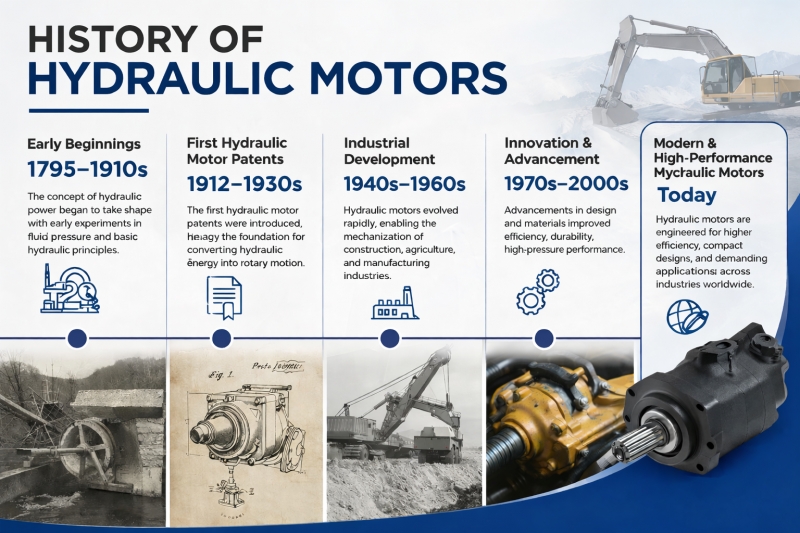
To develop a rotary hydraulic motor was by building William Armstrong, who swung the bridge over the River Tyne. For reliability, two motors are provided. Each is a three-cylinder single-acting swing engine. Armstrong has developed a variety of linear and rotary hydraulic motors for a wide range of industrial and civil engineering tasks, particularly docks and mobile bridges.
The disadvantage of this simple fixed-stroke hydraulic motor is that they use the same volume of water regardless of the load, so they are wasteful in terms of partial power. Unlike steam engines, because water is incompressible, it is impossible to throttle or control valve cut-off. To overcome this problem, motors with variable strokes were developed. Adjusting the stroke, instead of controlling the intake valve, now controls engine power and water consumption. Among them is Arthur Rigg's patented engine from 1886. It uses a double eccentric mechanism, such as a variable stroke power press, to control the stroke length of a three-cylinder radial engine. Later swash plate engines, hydraulic motors with adjustable swash plate angles would become a popular way to manufacture variable stroke hydraulic motors.
Hits: 【Print】
 Send Email
 wxid_13ugtgqwb0qg12
 xusxuan89
 CY Hyhraulic